


The Low Maintenance Botanicals That Survive a Dubai August
August in Dubai is the month plants get abandoned. Not deliberately — but between summer travel, extended family visits and the general sense that nobody quite knows what week it is, watering schedules fall apart. You leave for eighteen days, turn the AC down to save on the DEWA bill, and come home to a fiddle leaf fig that has quietly given up.
The instinct after that is to declare yourself bad with plants. It’s usually not true. What’s actually happening is a mismatch between the plant and the conditions — and Dubai’s summer conditions are genuinely unusual. The fix isn’t more discipline. It’s choosing botanicals built for the way you actually live.
What really kills houseplants in a Dubai summer
It’s rarely one dramatic event. It’s the combination:
Glass and afternoon sun. A west-facing window in August is a heat trap. Even behind curtains, the air immediately beside the glass can run considerably hotter than the rest of the room, and leaves resting against it scorch fast.
The AC swing. When you’re home, rooms sit at 22–24°C in very dry air. When you travel and turn the AC up or off, the same room can climb into the high thirties with humidity rising alongside it. Most tropical houseplants tolerate one of those states. Very few tolerate the swing between them.
Watering that isn’t wrong, just irregular. Two waterings in one week, then nothing for three. Roots that alternate between saturated and bone dry are the single most common cause of houseplant decline in apartments here.
Direct airflow from vents. A plant sitting under a ceiling vent is being wind-dried around the clock.
Once you see the pattern, the solution becomes obvious: choose botanicals that either regulate their own water, store their own water, or need none at all.
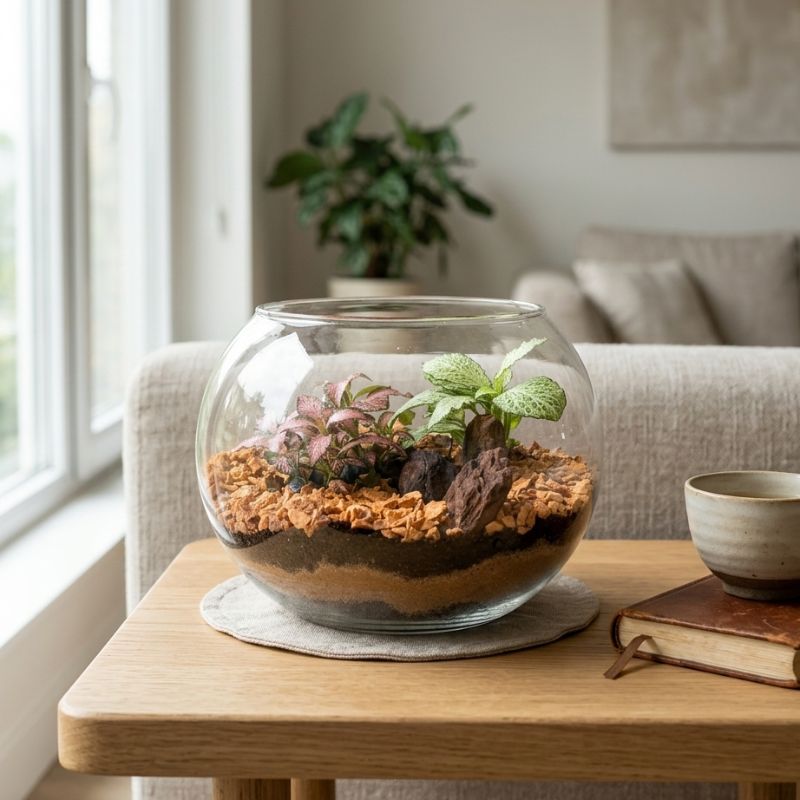
Terrariums: a sealed climate that ignores yours
A closed terrarium is the closest thing to a self-managing plant. Moisture evaporates from the soil, condenses on the glass, and runs back down — a small water cycle that repeats indefinitely. A well-balanced closed terrarium may only need topping up every few weeks, and some go considerably longer. That makes it genuinely well suited to a household that disappears for a fortnight without warning.
The plants inside are usually humidity-lovers that would struggle in the open air of an air-conditioned Dubai apartment: ferns, fittonia, peperomia, moss. Sealed in glass, they get the tropical microclimate they want, regardless of what your thermostat is doing.
The one rule that matters: never place a closed terrarium in direct sunlight. Glass plus UAE sun creates a greenhouse effect that will cook the contents within hours. Bright indirect light — a few metres back from a window, or a well-lit hallway — is exactly right.
Open terrariums work differently. Without a lid there’s no water cycle, so they suit arid plants: cacti, echeveria, haworthia. They need more light and occasional watering, but they handle dry AC air beautifully and tolerate neglect far better than a fern ever will.
For most Dubai homes, the honest recommendation is: closed terrarium if the spot has soft indirect light and you travel often; open terrarium if you have a genuinely bright room and prefer a sculptural, desert look.
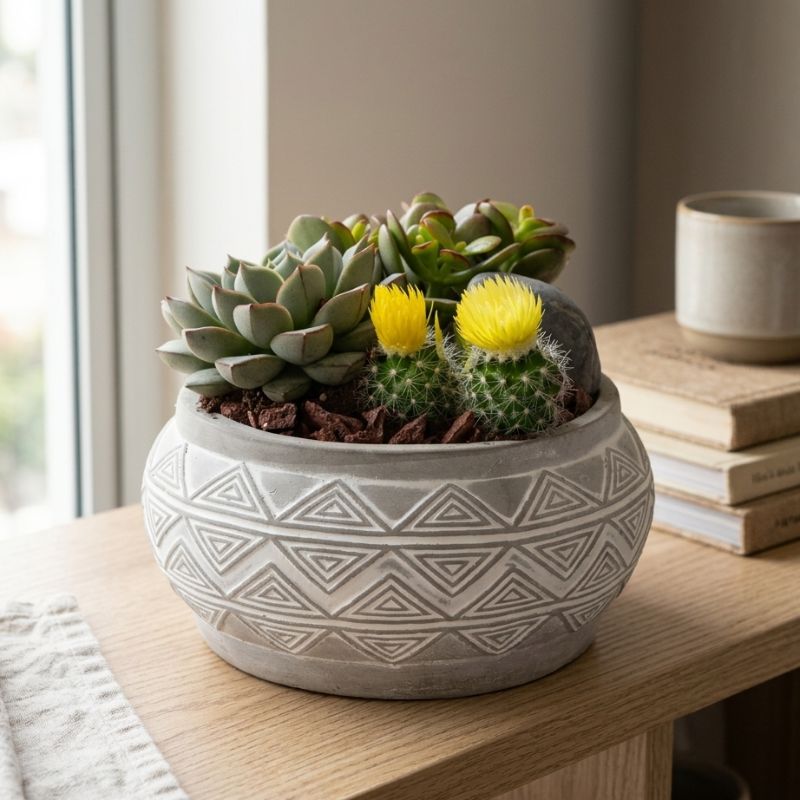
Succulent arrangements: designed for exactly this climate
Succulents store water in their leaves and stems. That’s the whole mechanism, and it happens to be a near-perfect match for a Dubai apartment — dry air indoors, long gaps between attention, bright light available most of the year.
The mistake people make is kindness. Overwatering kills far more succulents in the UAE than drought does. The reliable method is to water thoroughly, let the water drain completely, then leave the soil to dry out entirely before watering again. In an air-conditioned room, that often means every two to three weeks — but check the soil rather than the calendar, because pot size, light and AC settings all shift the timing.
Two other things worth knowing:
- They need real light. A succulent in a dim corner will stretch, pale and lose its compact shape. This is the most common complaint we hear, and it’s a light problem, not a watering problem.
- Drainage is not optional. A decorative pot with no drainage hole will hold water at the roots. If you love the vessel, plant into a liner pot that can be lifted out.
A composed succulent arrangement — several varieties, contrasting textures, one shared container — is also simply a better-looking object than a single plant on a windowsill, and it asks almost nothing of you in return.
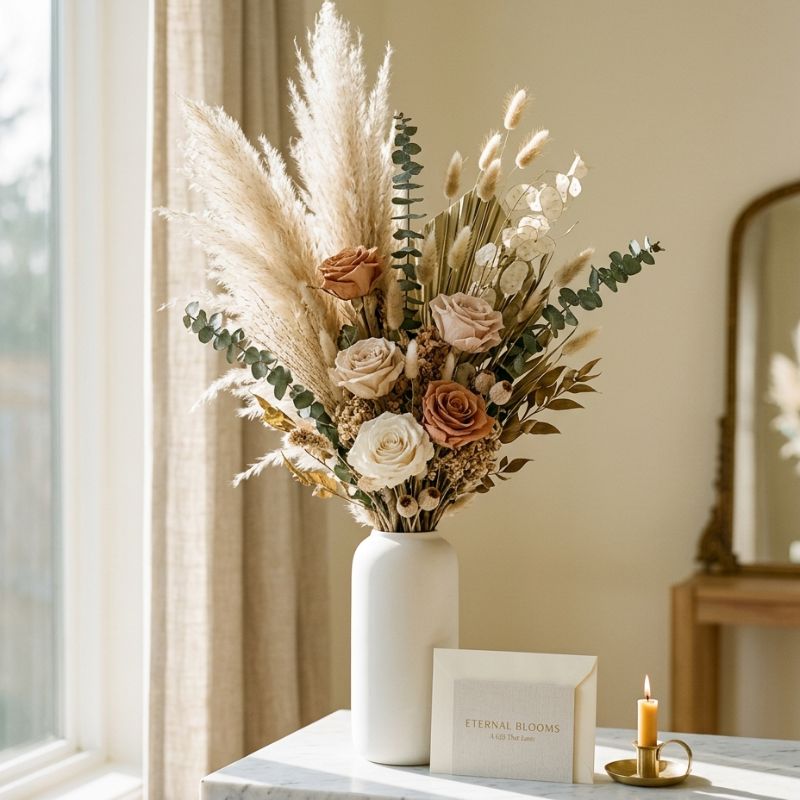
Dried and preserved arrangements: zero water, real presence
If your summer schedule is completely unpredictable, this is the category that removes the variable altogether.
Dried flowers are air-dried natural blooms — pampas, bunny tails, statice, ruscus, wheat, lavender. Preserved flowers are real flowers whose natural sap has been replaced with a preserving solution, which keeps them soft, supple and lifelike long after a fresh stem would have gone. Neither needs water, light or feeding.
They aren’t maintenance-free in every sense, though, and the Dubai-specific advice matters:
- Keep them out of direct sun. UV fades dried and preserved petals, and pale or dyed tones show it first.
- Humidity is the real enemy here. If you switch the AC off while travelling, indoor humidity in a coastal Dubai August can rise significantly. Dried stems may droop or, in the worst case, develop mould. An arrangement kept in a room with some air circulation, away from open balcony doors and bathrooms, fares much better.
- Dust, don’t wash. A cool hairdryer on the lowest setting, or a soft brush, is all that’s needed.
Kept sensibly, dried and preserved arrangements often stay beautiful for a year or more — though longevity depends on light, humidity and handling, so treat that as a range rather than a promise.
Choosing based on how you actually live
| If this sounds like you | Choose |
|---|---|
| Away for two to three weeks at a time | Closed terrarium or preserved arrangement |
| Bright, sunny apartment; home most days | Succulent arrangement or open terrarium |
| Low light, no reliable window | Dried or preserved arrangement |
| You want something living but forget to water | Succulents |
| You want zero upkeep and no anxiety | Dried or preserved |
There’s no hierarchy here. A preserved arrangement isn’t a consolation prize for people who can’t keep plants alive — it’s a design decision with a different set of properties.
A quieter reason to choose them
Bringing it into your home
House of Flowers offers terrariums, succulent arrangements, indoor plants and dried and preserved collections, and the right choice usually comes down to two questions: how much light does the spot get, and how often will you actually be home?
If you’re unsure, start with one arrangement in the room you use most. Get a feel for how it responds to your AC, your light and your schedule — then build from there.
Explore terrariums, succulent arrangements and preserved botanicals at houseofflowers.ae and find something that survives your summer, not just the season.
FAQs
What are the best low maintenance plants for a Dubai apartment?
Succulents, cacti, closed terrariums and preserved or dried arrangements are the most reliable options. Succulents store water in their leaves, closed terrariums recycle their own moisture, and dried and preserved arrangements need no water at all — all of which suit air-conditioned interiors and irregular schedules.
How often should I water succulents in Dubai?
Water thoroughly, let it drain fully, then wait until the soil is completely dry before watering again. In an air-conditioned room this is often every two to three weeks, but check the soil rather than following a fixed schedule — pot size, light levels and AC settings all change how quickly it dries.
Do terrariums need direct sunlight?
No. Closed terrariums should never sit in direct sunlight, because glass concentrates heat and can damage the plants inside very quickly. Bright indirect light is ideal. Open terrariums with cacti and succulents need brighter conditions but still benefit from protection from harsh afternoon sun.
Can I leave plants alone while I travel from Dubai in summer?
Closed terrariums, succulents and preserved arrangements handle absences of two to three weeks far better than tropical foliage plants. Before you leave, move plants away from windows, avoid placing them directly under AC vents, and water succulents thoroughly rather than lightly.
Are preserved flowers real flowers?
Yes. Preserved flowers are real blooms treated with a preserving solution that replaces the natural sap, keeping the petals soft and lifelike. They need no water, sunlight or feeding.
How long do dried and preserved flowers last in the UAE?
With sensible care — out of direct sunlight, away from high humidity and bathrooms — they commonly stay attractive for a year or longer. Fading and drooping are usually caused by UV exposure or moisture rather than age.
Why are my succulents stretching and losing their shape?
That’s etiolation, and it means insufficient light. The plant is reaching for a brighter source. Move it closer to a well-lit window; the existing stretched growth won’t reverse, but new growth will return to a compact form.
Are terrariums or succulents better for a low-light room?
Neither is ideal. Succulents need bright light, and even closed terrariums require decent indirect light. For a genuinely dim room, a dried or preserved arrangement is the more sensible choice.
